
What's Really Hiding Behind Your Bathroom Tiles?
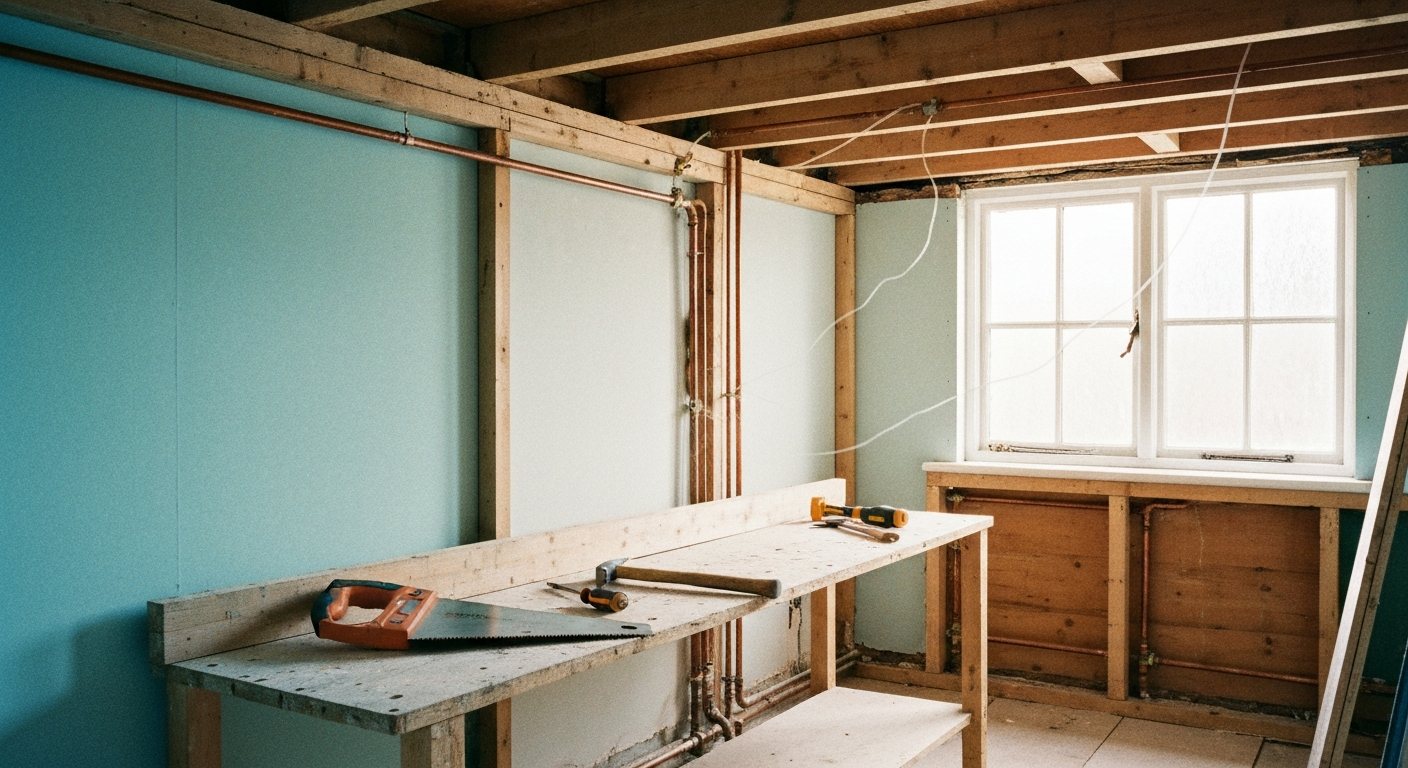
People ask us the same questions again and again, usually right before they commit to a bathroom refit. Fair enough. It's a big spend and nobody wants surprises halfway through. So George and Joel sat down and answered the four we hear most, with no sugar coating.
What are the most common hidden plumbing problems you find when ripping out old bathrooms in Surrey and Berkshire?
The housing stock around here tells you most of the story. Lots of Victorian and Edwardian terraces, 1930s semis and 60s and 70s builds, and each era hides its own problems.
- Rotten floors and joists: The most common cost-adder by far. A bath or shower that has been leaking slowly for years, often just a failed silicone bead or a weeping trap, soaks the subfloor and the joist ends. Nobody knows until the bath comes out.
- Lead and imperial pipework: Pre-1970s homes often still have lead supply runs, or imperial-sized copper that modern metric fittings will not connect to cleanly. Lead has to go, and part-replacing imperial pipe usually turns into re-running the whole feed.
- Limescale: Surrey and Berkshire have some of the hardest water in the country. Old pipes can be half closed with scale and gravity-fed cylinders are often furred solid. That is why the "my new shower has no pressure" conversation happens so often.
- Corroded or botched soil stacks: Cast iron stacks rusted through behind boxing, or previous DIY where the toilet waste has almost no fall. Asbestos also shows up here. Old soil pipes, bath panels, floor tiles and pipe lagging in pre-1980s homes all need testing before removal.
- No working isolation: Seized stop taps and zero isolation valves, which means even a small job needs the whole house drained.
Our honest advice: on any pre-1980 property, allow a contingency of 10 to 15 percent, because the tiles and floor are hiding the last 50 years of other people's shortcuts. It is also why every Novo estimate starts with a proper survey, not a guess over the phone.
What's the worst DIY plumbing mistake you've had to rescue a homeowner from?
Joel's answer to this one is instant. A homeowner had plumbed his own shower using push-fit fittings buried behind a tiled wall. No access panel, no pipe inserts. One fitting let go six months later and ran inside the stud wall, through the kitchen ceiling below, and took out the lighting circuit. By the time we were called, it needed a full re-board and re-tile of the bathroom wall, a new kitchen ceiling and a partial rewire. Thousands of pounds of damage caused by a fitting that costs less than a takeaway, installed wrong.
Close second: someone who adjusted their own soil pipe and left it with almost no fall. Six months of slow blockages before the smell finally gave it away.
The rule we take from both: anything that ends up hidden behind tile or under a floor gets pressure-tested before it is closed in. No exceptions. It is one of the stages baked into the Novo Method, and it is why we can stand behind every bathroom with the 12-month Novo Guarantee.
How do you handle water shut-offs when a family is living in the home during a 2 to 3 week refit?
Planning, mostly. On day one we fit full-bore isolation valves so the bathroom can be shut off on its own without killing water to the whole house. After that, turning the mains off becomes a rare, scheduled event rather than a daily nuisance.
When we do need the whole house off, it is agreed with you the day before, done between the school run and lunch, and the water is always back on by evening. If it is your only bathroom, we keep the toilet working overnight for as much of the job as physically possible, and we tell you in advance about the one or two nights it will not be.
The rest is respect for the fact that you live there. Dust screens up, floors protected, tools packed away and a tidy-up every day. A 2 to 3 week refit is perfectly liveable when you always know what is happening tomorrow. George runs that communication personally on every job.
Which invisible plumbing upgrades do you insist on for a high-end bathroom?
The parts you never see are what make a bathroom feel expensive five years later, not just on handover day.
- Full-bore quarter-turn isolation valves on every appliance, so future maintenance never means draining the house.
- 22mm feeds to rainfall showers and bath fills. A standard 15mm supply will strangle a top-end shower no matter how good the valve is.
- Pressure done properly. An unvented cylinder or mains-fed conversion rather than a noisy retrofit pump wherever the property allows it.
- Scale protection. With the hard water around Sunbury, Surrey and Berkshire, a water softener or at minimum an inline scale inhibitor. Without it, a matt black tap and a glass screen will look tired within months.
- Thermostatic blending valves for scald protection, especially with kids in the house.
- A leak-detection shut-off valve if the bathroom sits above a kitchen or living room.
- Access panels designed into the joinery, so nothing serviceable is ever tiled in permanently.
None of these show up in the photos. All of them show up in how the bathroom performs for the next decade, and every one of them is covered by the 12-month Novo Guarantee.
Thinking about your own bathroom?
If any of this sounds like your house, the easiest first step is our online estimator. Answer a few questions about your bathroom and you will get a realistic estimate in 60 seconds, not a sales visit. Try it at www.novoplumbing.com/estimate and George or Joel will take it from there.